NetRunner - teaches the NMap tool in a gamified experience
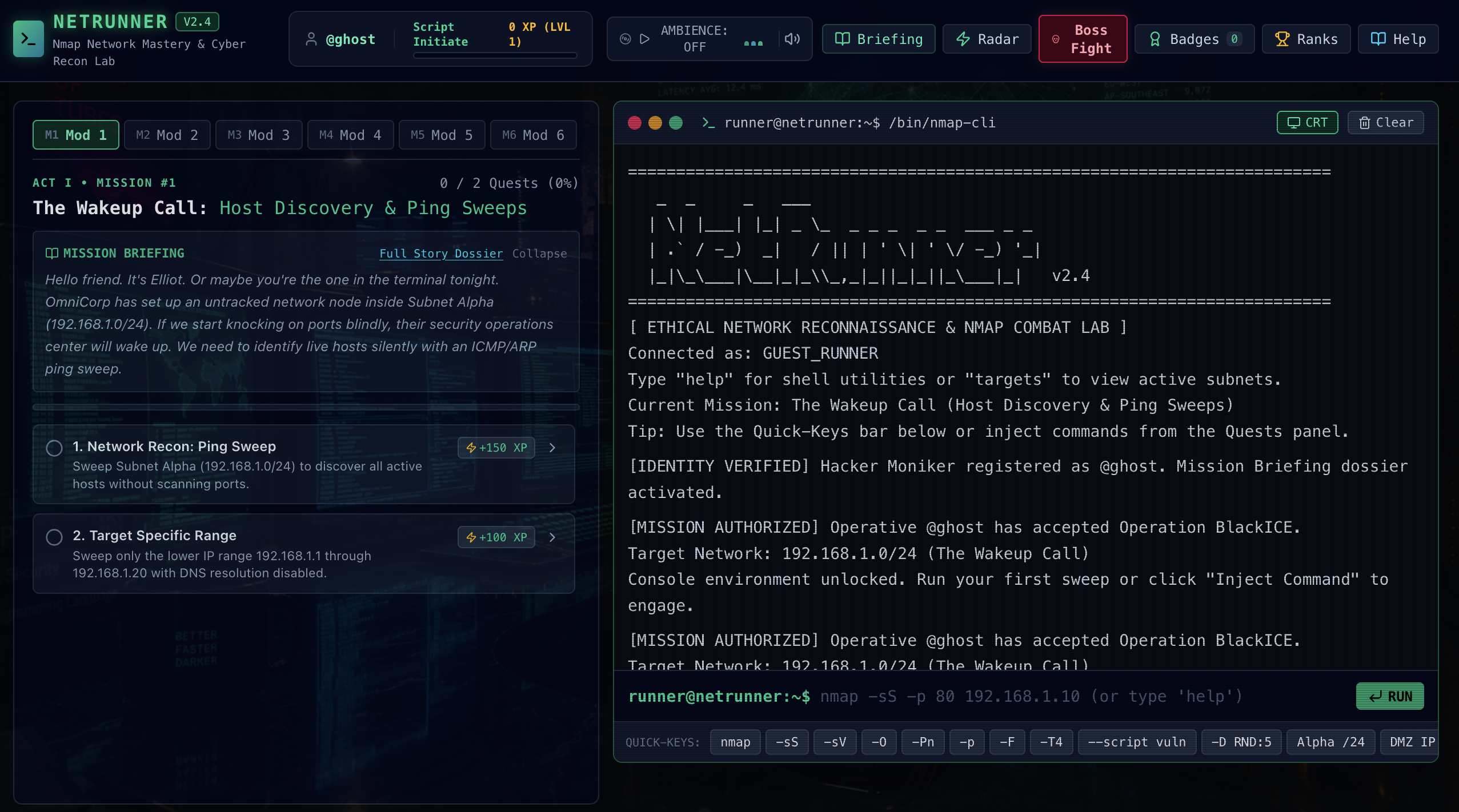
The site at netrunner.branesworld.online is similar to mrelliot.branesworld.online - an interactive, story-driven learning app designed to gamify beginner Linux networking skills.

The Netrunner site adapts cyber-themed storytelling into a browser-based quest to teach practical technical skills. Rather than having learners read dry reference manuals or textbook theory, the teaching method relies on interactive terminal challenges and mission-style scenarios set against a cyberpunk backdrop.
Students learn by doing, solving network security puzzles and running simulated command-line exercises step by step.
GAMIFICATION
Gamification works because it swaps passive listening for direct participation. When someone learns through a game mechanic, every choice produces an immediate reaction.
Instant feedback loops keep attention locked on the task, turning what could feel like abstract homework into an active problem to solve. Instead of memorizing concepts in isolation, learners test hypotheses in a sandbox where making a mistake carries zero real-world risk. That psychological safety removes the paralysis people often feel when encountering intimidating technical material.
In complex subjects like cybersecurity, computer programming, organic chemistry and clinical medicine, the observed results are especially clear. Research consistently shows that game-based learning improves long-term conceptual retention and boosts active engagement compared to conventional lecture formats. Because complex topics require juggling multiple variables at once, standard rote study often leads to cognitive overload.
Gamified platforms break those massive systems into progressive, bite-sized quests. Learners grasp foundational mechanics first, build genuine competence through small wins and naturally step up to advanced challenges.
Beyond test scores, the biggest observed gain is the development of practical intuition. Medical simulators, coding sandboxes and simulated network defense environments demand applied troubleshooting rather than simple recall. Learners must evaluate situational clues, adapt to unexpected constraints and iterate on solutions under simulated pressure.
Over time, that trial-and-error cycle builds pattern recognition and structural understanding that stick far better than simply highlighting a textbook.